
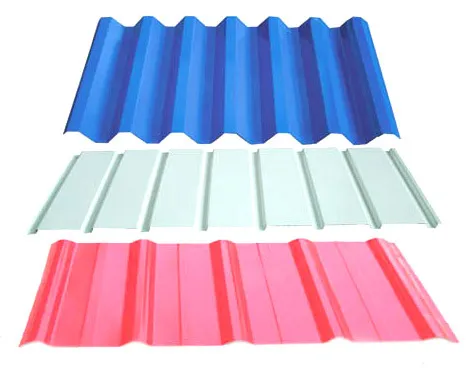
If you are planning to take up a roofing project or a project involving the use of Colour Coated Sheets, there is one thing that would be on your mind. How much quantity would be needed for your project?
Well, to be honest, it may sound like a very simple calculation, but the reality is that there is a high probability of getting the calculation wrong. Many times, people order less material or more material, which leads to a waste of money.
The fact is that the calculation for the quantity of Colour Coated Sheets is not a very complicated process. It is just a matter of taking the right steps and having the right knowledge about the process.
Step One: Calculating the Sheets
In order to calculate the area, two values are required. One of them is the length of the surface, while the second one is the width of the surface.
Assume that the length of the roof surface is fifty feet, while the width of the surface is twenty feet. When these two values are multiplied together, the result obtained is one thousand square feet.
This is your starting value, and all the calculations will be based on it.
Step Two: Understanding the Concept of Effective Width
This is one of the most important steps in the entire calculation, but it is also one of the most misunderstood concepts. As a leading Colour Coated Sheets Manufacturer in India, we can say that in every sheet, there is something called the actual width.
In the real world, it is not possible to keep two sheets adjacent to one another without overlapping them by a small margin, as it would cause leakage of water and would compromise the strength of the structure.
This means that the full width of the sheet cannot be utilised. Only a portion of it is actually being utilised, and it is called the effective width.
Assume that the actual width of a sheet is one thousand millimetres, but its effective width is nine hundred millimetres. You should never forget the difference between actual width and effective width, as it would affect your calculations.
You should always use the effective width of the sheet instead of the actual width.
Step Three: Calculation of the Area Covered by One Sheet
To calculate the area covered by one sheet, it is necessary to know the effective width of the sheet. A Colour Coated Sheets Manufacturers in India can help you with this. For example, if the length of the sheet is ten feet and the width is three feet, then the sheet will cover thirty square feet.
This figure tells you how much space one sheet can handle.
Step Four: Calculate the Total Number of Sheets Required
Now that you have both figures, the total project area and the area covered by one sheet, you can calculate the number of sheets we will require for our project.
You can do this by dividing the total project area by the total project area covered by one sheet.
Let us continue with the example. You have a project area of a thousand square feet, and one sheet can cover thirty square feet. You will therefore require a little over thirty-three sheets.
However, you can not buy a fraction of a sheet. You therefore round up to the next whole number. So, you require thirty-four sheets.
Step Five: Add Extra Sheets for Safety
In a real-world scenario, you can not just order the exact number of sheets you will require. There will always be some loss, some small amount, which will occur as you go through your project. You might have to cut some of the sheets so that they can fit into the edges or corners. Some might get destroyed as we go through the project.
To avoid all this, you need to add a small margin. Add between five and ten per cent more. If you had calculated that you would require thirty-four sheets, you can therefore consider adding a few more, say thirty-six to thirty-eight.
Not all projects have a simple layout. The shape or design of the structure is also a factor to consider when determining the number of sheets you will need.
For flat surfaces, the above formula is applicable with little or no wastage.
For sloping roofs, the sheets will be placed along the slope. This may result in the use of a few more sheets than the actual requirement.
For complex designs with multiple angles or sections, cutting is necessary. This increases the amount of wastage as well as the actual sheets needed.
Thus, always consider the structure of the place you want to cover.
Step Seven: Understand the Role of Sheet Profile
The profile or design of the sheets is also a factor to consider when determining the actual sheets you will need.
- Corrugated sheets require greater overlap, which reduces the coverage of each sheet.
- Trapezoidal sheets have greater coverage than corrugated ones.
Thus, you may be able to use fewer sheets than the actual requirement.
For example, two different projects with the same coverage may require different numbers of sheets depending on the profile or design of the sheets.
Step Eight: Plan the Installation Direction
Another factor to consider is the direction in which you will place the sheets. In most cases, the sheets are placed from top to bottom along the slope. This is to ensure good drainage and prevent leakage.
If you do not plan the installation direction properly, you may be forced to use a few more sheets than the actual requirement.
Discussion with the installer can help you avoid the use of a few more sheets than necessary.
Conclusion
The calculation of the quantity of color coated sheets required is a simple process. To do this, you must obtain the exact measurement of the area. In addition, it would be important that you understand the concept of the effective width. Finally, it would be important that you add a small margin.